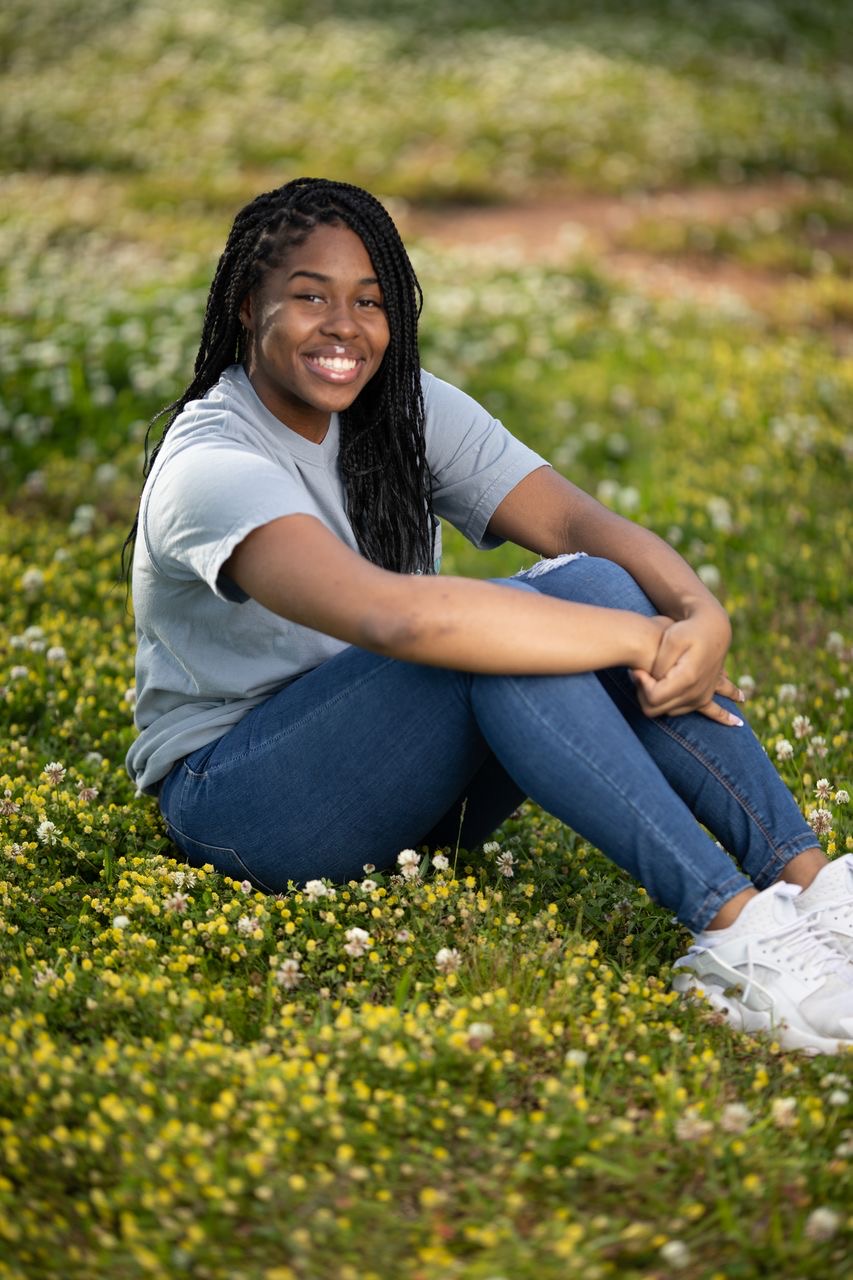
 Always looking to give people the benefit of the doubt, Christina could not be sure, she said, that the incidents on the basketball court were racially related. Others would probably not have been so generous in their assessment. At 5’7” with her hair up, she is often smiling when she’s playing basketball. But she is a fierce competitor on the court and, in fact, will be playing basketball in college at Washington University in St. Louis next year.
Born and raised in Stockbridge, Georgia, Christina is 18 and recently graduated from the Paideia School. She has lived in Stockbridge her whole life with her parents and younger brother, about 20 miles south of Atlanta. She attended a public elementary school, a private Christian middle school and a private high school that is mostly white. She voted for the first time on the day we spoke. The events of the last few months have resulted in her experiencing a good deal of grief.
How often do you feel like racial discrimination affects you? Personally, I think I’ve had a better experience compared to family members and friends. A couple of incidents come to mind, but there’s also part of me that’s hesitant to consider these events “racial discrimination.” I always like to see the best in things, so I can’t confidently tell you whether these incidents happened because of my race or any other part of me.
There have been instances where white people have said that I’m scary or that they are scared of me. I find these comments odd because I’m average height but I’m also strong in stature. You can see that when you look at me, so maybe they meant my strength.. Or maybe it’s my race… or maybe it’s both. When the basketball team and I were at a Christian school in Forsyth, Georgia for our game, I was shooting free throws and somebody yelled “watermelon” while I was shooting. And turns out it was actually a 12 or 13 year old girl. Her mother claimed she had no idea why her daughter yelled this out when she later came over and spoke to my dad. She claimed that she’d never raised her daughter to have any racial bias. But if I can insert my opinion… parents need to have a conversation with their kids about stereotypes and other race-related issues early.
There was another incident when we were playing a predominantly white school. I was going for the ball alongside another girl. We never made contact, but she ended up falling and her leg twisted the wrong way. She started screaming. Her mom comes on the court and is looking at me like she wants to strangle me. Then we go back to our bench, and the mother is still looking at me like she wants to strangle me while her daughter is in pain. After the game, I went to check on her, and they were both very cold. But again, in that play, we never made physical contact. She knew that. I can’t tell you exactly what that was.
In that case, should an adult have come over to intervene? As a child, it would be disrespectful for me to come at an adult like ”why were you looking at me like that?”… I think that it would have been helpful for someone to say something and go get their story. In this particular situation, I thought about what my parents would’ve done in that situation, and that parent’s reaction was not it. As much as I’ve been hurt by other players in 10 years worth of basketball games, my parents have never mean-mugged, glared at, or blamed a child for hurting me. So why did she treat me that way? Take that experience on my end with various comments in the stands from opposing white parents about my “scariness,” and I’m left confused as to why I’m being targeted.
Have you and your immediate family had experience with police brutality? Personally no, but my dad says he has quite a few stories. He shared one that probably stings the most. He was raised in the North, and when he was a kid, he dropped off newspapers for people. He went to a white couple’s house and knocked on the door and said, “I’m here to collect for the newspaper.” The woman asked him to come in, and the husband said, “don’t let that n-word in my home.” He was a New York State Trooper.
Do you feel you’ve had to separate your personal life from school in any way? Do you feel like there’s any part of you you have to hide at school? I wouldn’t say hide, but [my personality] definitely gets dumbed down. My personality is the same wherever I am, but it manifests in a different way depending on where I am. Over time, I’ve learned how to balance and develop these two “sides” of me, if you will. I’ve played basketball my whole life, and most of the people I’ve played basketball with have been black. But then for school, I’ve been in white institutions for 6 years and counting. My parents have molded me the most though. And I think in both of those communities, I’ve been myself; it just took time to fully express some parts of myself. Earlier in life, I had the mindset that my schools would accept me as I was, but I wasn’t comfortable being that person. Being one of few black people in my grade level each year also led to me trying to “dumb down” my personality.
What do you wish white people really understood about your experience as a black person? Not all black people are the same. There are tons of misconceptions about the black experience. I think it’s important to understand that your mindset [as a white person] may be problematic, and that it could be affecting people around you. Also, understand that sometimes, my experience as a black person is affected by your existence. For example, take code-switching. Because of the way white America rules the country, it’s wired into many black people’s brains that when you go into spaces like Paideia and even America, you are entering a “white space.” And in order to keep the peace or even get a job, you have to assimilate to some extent. That’s a weird and unfortunate dynamic.
Are we making progress in the U.S. on these issues compared to your parents’ generation? Yes and no. Yes, in the way that social media is so important especially in movements like Black Lives Matter because of the way things are being recorded and posted on social media. People are readily able to expose anyone that’s racist or ignorant to get things addressed. It’s also a great way to spread awareness for people to explore and educate themselves about things that are happening today.
On the flip side, as many people are being enlightened, just as many people are being born to parents with ignorant mindsets. I personally believe you are not born racist, but you are taught how to navigate life based on the people around you.
Is this moment going to stick or be another passing chapter in race relations? I think in some shape or form it’s going to stick, but it might look a little different. If you take the civil rights movement, for example, that took a lot of people, mostly people of color, to be persistent. But with this movement and recent atrocities, our focus is on educating people, specifically everyday white people and white people in positions of power. They, actively and inactively, are contributing to a system that is [built] against black people and other people of color. People now are not letting up. I can understand that this is a lot being asked [of white people] to think about the impact of their actions with regard to how they’re impacting another race. But, it’s something that needs to be done. The longevity of this period of activism depends on how much people want to be educated and do their part. Https:Blacklivesmatter.carrd.co is one of the many great resources out right now.
How have you reacted to the deaths of George Floyd, Breonna Taylor and others? It took a while for me to come to terms with my emotions in the last couple of weeks. The last thing I wanted to do was to talk to anyone, especially a white person, because there was no way for them to understand what I was going through. As I came to terms with everything, I started being hypersensitive to the words and actions of my white friends. When people reached out to say they were here for me, it helped me feel I could reach out to them and tell them what they can do.
I’ve used my social media platform to keep my followers informed about petitions they can sign, places they can donate, ways they can be activists and different black businesses they can support. I’ve taken the time to interview black girls about their feelings during this time in order to amplify their voices as well. I have also been blessed to be able to speak with one of the lead investigators in the George Floyd case. Knowing that I know someone in touch with what is happening with the case and is fighting for justice has also helped my process.
What things would you like to see white people you know do to help?
– You can’t make an informed opinion without being educated. So educate yourself; push yourself and be open to what you are about to experience. Do that research on your own.
– Actively educate your kids about racial stereotypes and why they are harmful.
– Support black-owned businesses. I know it’s easy to support the mass market, but be more cognizant of where you are putting your money.
– If you have a social media platform, use it. Share what you learned.
– Don’t be afraid to do something about the people in your life who don’t support you in your quest to learn more… Personally, if someone in my life can’t appreciate and understand certain parts of my background, they could be contributing to a huge problem in my life if they choose not to do anything.
– If you are comfortable protesting, that act alone is very powerful. I think it’s very special seeing white people being the defense between black people and police. I think that sends a powerful statement to those watching.
Does Atlanta have a special role in this issue? Atlanta is the best city in the country for a lot of reasons; we were arguably the heart of the civil rights movement from the 1900’s. There are so many civil rights leaders and activists that come from Atlanta that have large platforms who can amplify the little people’s voices. We have some great political figures here making decisions for us as well. The people here care. We have leaders who care.
What other relevant questions should I be asking? It depends on how personal people want to get, but you could ask how we’ve had to cope with being black [given all the latest current events]. I know for me, I have done a lot of self-care as I have been going through some stages of grief. First, seeing the events happening. Then, not knowing how to react to it. Then, being in this gray area like “wow, this is really happening.” Then just sitting there going through social media where every post is related to the current climate. My true pain and complete acknowledgement of this country’s horrific state started when I was thinking about my [younger] brother and thinking about what would happen if he was in the wrong place at the wrong time… And he is my whole world. So once I started thinking about that, I felt a surge of anger, sadness and the need to do something all at once. That was my process.
 Worthwhile Voices
Wonderful interview. Thank you and Christina for sharing.
LikeLike