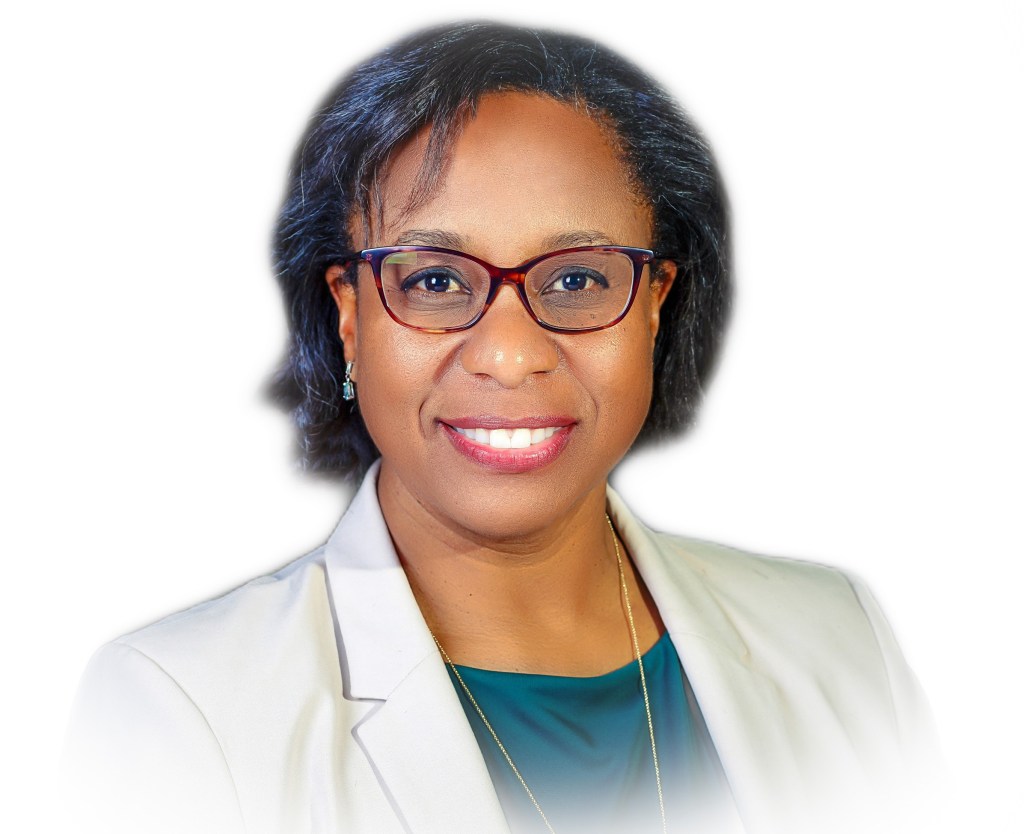
Because she is fun loving and easy going while still being a formidable executive, it seems it would take a lot to get under her skin. Mona describes herself as a glass half full kind of person. Yet the events of the May and June in U.S. race relations have left her frustrated and struggling to process it all. Mona has been frustrated that not all of her white friends see the inequity and the racism built into our society.
Living in Jamaica, Canada and the U.S. for extended periods of time growing up has definitely had an impact on Mona’s perspective. Her parents’ Jamaican heritage is a strong part of her identity. She describes her extended family as having as many colors as the United Nations. She is married to Bob, who is white, and they laugh that he is 100 percent Irish. They have two daughters and live in Morningside.
Most recently, Mona works for Delta Air Lines as Director of Elevated Service Delivery. In addition to her regular duties, she is currently leading and facilitating a diversity and inclusion initiative within her division at Delta that started in May in response to recent events.
How often does racial discrimination affect you? Almost every minute. There is constant decision making on how I feel I will be perceived and how to avoid risk. We have to restrict ourselves and our options, for example on vacations, to where we feel we will be accepted. This has an economic impact as well. We may have to pay more to go somewhere that we know we will be safe and accepted.
Have you or your family had an experience with police brutality? My immediate family of four has not had any direct experience with policy brutality, but my father and my brother certainly have. They have been pulled over for no reason and accused of or charged with offenses. Because of our privilege, we were able to hire someone to fight the charges. In the last few years, my father, who is in his 70s, was handcuffed and taken to jail for DUI when he wasn’t drinking; my brother was married to an El Salvadoran woman. Her parents were visiting and pulled over and accused of an offense. Her father was splayed up against a car with a gun drawn against him. My brother was able to come and somehow diffuse the situation. Both my brother and my father have had a gun pulled on them by law enforcement in Cobb County.
Do you feel you’ve had to separate your personal life from work? Do they know what you have gone through with regard to race? I am known for being an authentic leader, and I consciously speak often about my family, in general. Employees and co-workers feel they know my husband and my kids well because I talk about them so much. However, I do not tell them about the challenges I have. For example, my family was threatened when renting a cabin in Blue Ridge, Georgia for a long weekend. People came to the bottom of the street where we stayed, loitered and looked up at our house. Someone played a banjo. Then I was sued by the owner, accused of having more people in the house than allowed. Here I was, the CEO of a company being accused of this. I had an attorney friend helping me fight it legally. Yet, I never once told my partners or my team what was going on.
What do you wish white people really understood? I am starting to deal with what I have held inside over the years. I am frustrated. It’s increasingly hard for me to understand why my white friends don’t see racism, or understand or believe the systemic nature of it. It’s getting harder for me to see them do, and importantly, say nothing.
Up until this moment in time, I think there was an unstated belief among my white friends that I, Mona, am the exception to the rule and that I’m different from their perception of other black people. It’s something I’ve always felt. I have black girlfriends who I get together with, and we talk about this phenomenon. That it feels like some of our white friends probably have some conscious and unconscious racial biases that they may not share with us, but that it almost feels like they put us in a separate bucket where we are again “exceptions to the rule” of how they may view the greater population of black and brown people.
The more public racist events of the past month or so has definitely allowed an opportunity for more authentic conversation between people, and I have taken the opportunity to be more vocal and specific with family, friends and colleagues that I am in no way exempt from the pain, discrimination, and hate. The struggle is indeed very real for me. Every. Single. Day. I posted on Facebook on Mother’s Day that I had enjoyed my day, but that the silence [of my white friends], was deafening. How anyone who I care about, or who cares about me, or humanity in general, can witness these racial events (now fully available for all, who were in disbelief that this happens every day, to see) and not speak up, is soul crushing.
Do you think this moment of recognition in the U.S. will stick? I’m always a glass half full kind of person. But I’m increasingly leaning toward this being more of a passing moment. I have been having a lot of hope and feeling proud of my friends who are beginning to speak up and take action. But America is a place that needs immediate gratification. It’s hard for me to see this groundswell of support lasting long enough to make the systemic change that is needed. Perhaps since there has been such an incredible global response to the Black Lives Matter movement, there may be more motivation for our country to do the hard work to make systemic change, but I guess I am a little less than cautiously optimistic. I will, however, continue to do the work. I do also think more people will start treating each other with kindness in the everyday. And that is something that is needed.
Is there any action you support being taken in Georgia? Pass the Hate Crimes Bill in Georgia. That should be easy.
What should white people do to help?
- Keep breaking through the ignorance and seeking understanding of the black experience. Keep educating yourselves and being proactive about things to read or watch to better understand. Keep doing that.
- Do the research on economic empowerment and support black-owned businesses. Be conscious of where you spend your dollars.
What should white allies stop doing? I am getting weary of my friends who say “I don’t see color.” I want you to see me and my color and know that it’s beautiful. We need to appreciate the differences, not pretend they aren’t there. I think it’s a defense mechanism so that people can convince themselves they are good people. My pastor said this in a sermon one day, and a number of members of our congregation had to meet with him, call him and explain to him why this is hurtful.
How has your work with Delta on diversity and inclusion been going? We have been holding one-hour sessions that have been incredibly powerful. It has been raw discussion with people coming to terms with race in the U.S. today. The feedback has been amazing, and every session has resulted in people of all colors coming to tears as we all have the courage to share our perspectives and better understand the black experience. I have a role to play in this. This is one of the things that I can do to increase awareness. I am helping to scale this up by meeting with others who want to hold their own sessions in their office to help get them started.
 Worthwhile Voices
Mona, I see you and I think your color is beautiful- and don’t get me started on how beautiful your two daughters are. I am really glad to know a little more about your personal experiences. I am trying every day to increase my awareness by educating myself and supporting black owned businesses. Thank you for sharing.
LikeLike
Thanks so much for sharing Mona. I think the more opportunities we have to listen and hear, the better we will be in helping to ensure this isn’t just a moment in time.
LikeLike